Range ovens · Marina del Rey
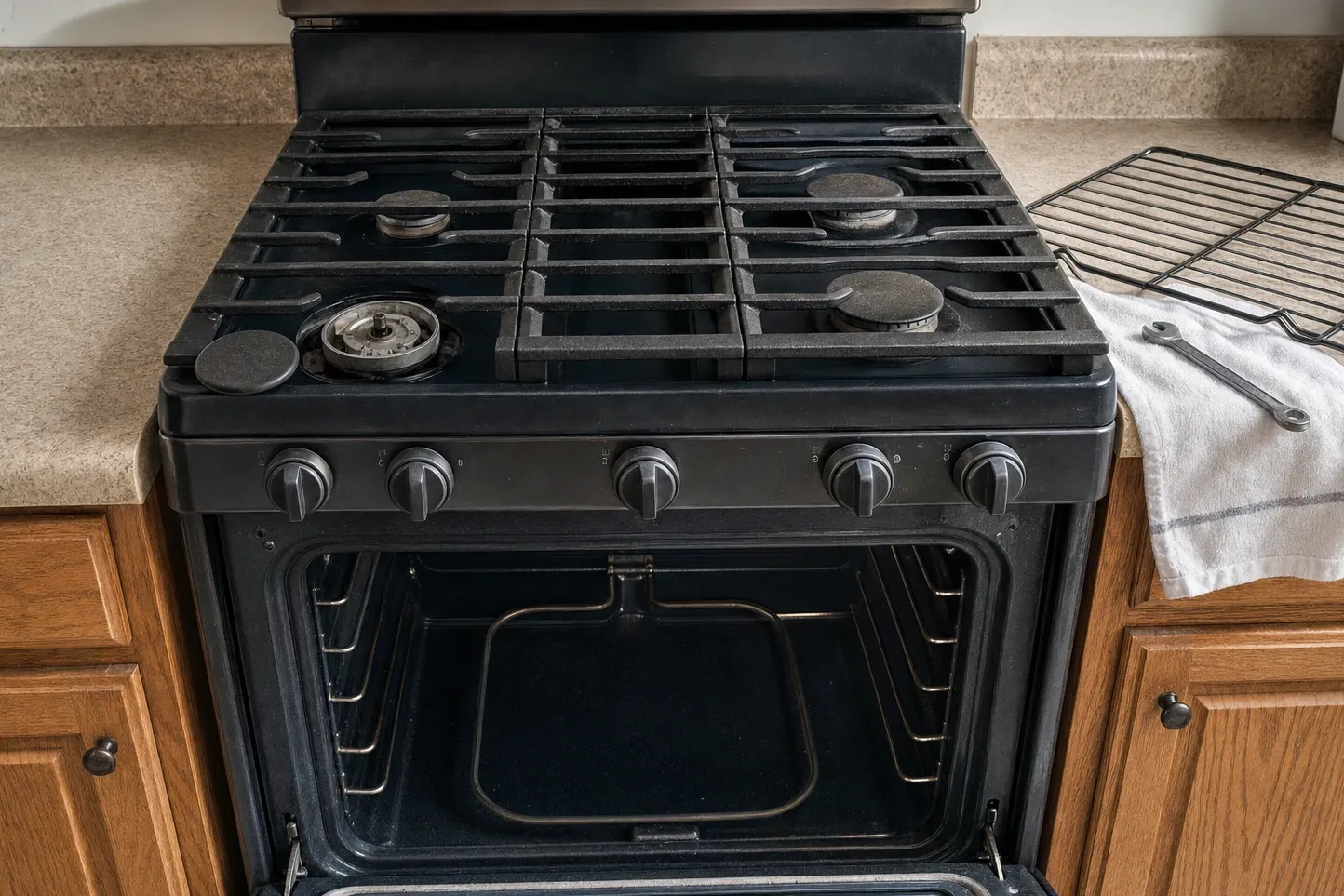
The Gas Oven Inside a Wolf All-Gas Range
In one line
An all-gas Wolf cooks with a flame and still has to be plugged in: a 120-volt supply runs the ignition, the light and everything behind that one oven knob. Los Angeles Wolf Repair Pros starts at the supply rather than at the burner — (310) 706-2347.
A gas cavity that wants a socket
Gas arrives through a three-quarter-inch line to a half-inch inlet with its own shut-off valve near enough to use, and the appliance also wants a grounded 120-volt socket on a fifteen-amp circuit of its own. Two things follow: the socket has to sit where the drawing allows and stay reachable, and in a power cut the burners can be lit by hand while the oven cannot.
The broiler, and the fan that waits
The broiler in this cavity is infrared, and the instruction with it is unusual enough to repeat: no preheat, door closed, the pan that came with the range, rack position rather than time deciding doneness. The convection fan is a button, not a mode — pressed only once the oven is at temperature, and fitted only to the full-size thirty and thirty-six inch cavities. Both arrive as complaints; neither is a fault.
Which GR is standing in the run
The GR series has been current since 2013 and the whole set is still listed: GR304, GR366, GR364G, GR364C, GR488, GR486C, GR486G, GR484CG, GR484DG, GR606CG, GR606DG and GR606F. The leading digits are the nominal width — a GR366 is a thirty-six, a GR606CG a sixty — and the opening follows that figure everywhere except the sixty, which wants sixty and a quarter inches. Height and depth come off the planning table rather than the badge: the range stands between thirty-seven and thirty-eight inches.
Salt air, and where the owner’s part ends
Marina del Rey moves damp air through a kitchen most of the year, and on a range it reaches the fixings first: screws behind the skirt, hardware around the door, plated parts under the grates. That decides how gracefully one comes apart the day it has to. The owner’s part is short. Confirm the plug and the breaker, and treat a flashing oven indicator as the range saying it lost the flame and dropped into lock-out — the knob goes off and on again to clear that. Burner, igniter and the gas valve are ours, the shut-off behind the range included: a valve left half-turned after a remodel is something a technician checks, not something an owner goes looking for.
Where this one turns up
Of the eight places on the round, Marina del Rey is where this series shows up most often.
Schematic of the sector, drawn for this page — the arrangement is true, the spacing is not to scale. Los Angeles Wolf Repair Pros works this sector and no other; anything outside it belongs to somebody else.
Three questions this raises on site
Why does an all-gas range need to be plugged in?
Because ignition, the oven controls and the light are electrical. The planning figures ask for a grounded 120-volt supply on a fifteen-amp dedicated circuit, a three-prong receptacle and a six-foot cord. Lose that and the surface burners can still be lit by hand, but the oven will not run at all.
Should the convection fan be on while the oven preheats?
No. The guidance is to wait until the cavity has reached temperature before pressing the fan button, because switching it on during preheat can make the oven shut down. The fan runs only with the door closed, and only the full-size thirty and thirty-six inch cavities have one.
Does a gas oven broil the way an electric one does?
Not quite. This cavity has an infrared broiler, and the instruction is to skip the preheat, keep the door closed and use the two-piece pan supplied, moving the rack rather than the clock. Los Angeles Wolf Repair Pros can separate a broiler fault from a rack habit on the phone, (310) 706-2347.
Signed off by
Gustavo Peralta
- Role
- Cooking-appliance technician — doors, hinges and seals
- In the trade
- 19 years
- Reached on
- (310) 706-2347
- On this page
- Range ovens — fit, door and cavity